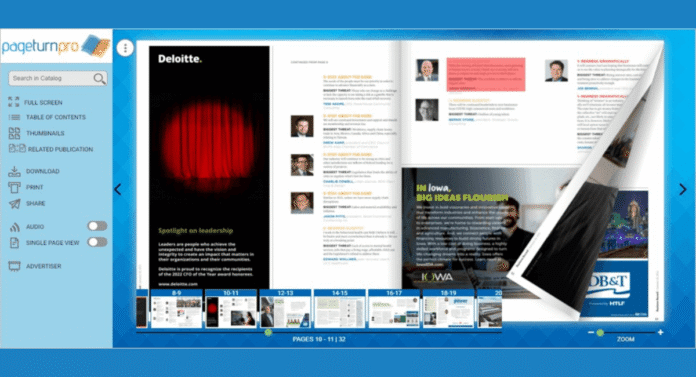
We have all been there. You spend weeks working on a brochure or a white paper. You grind your teeth about the copy, argue about the color scheme and eventually submit it to the printers or export it into a high-resolution PDF. Then, disaster strikes. After a week, you notice one of the mistakes on page three. Or pricing changes. Or a product goes out of stock. And all at once that fine piece of collateral becomes outdated. When it concerns print, you are literally throwing money in the garbage. In case it happens to be a PDF on your site, then you must visit the source file, make changes, re-export, and have your web developer re-upload. This process is tedious, costly and annoyingly inflexible. Still, there are a lot of marketing teams that use the same format to narrate the story of the brand. They consider digital contents as a digital copy of a bit of paper. There is a better way. Digital publishing software changes dead, 2-dimensional documents and makes them participatory and engaging.
It enables you to make your marketing collateral digital in a manner that is actually attractive to your audience and not to be a scroll that they have to go through. This is why it is time to get rid of the stagnant PDF and why digital publishing can make your content strategy work again.
The Revolution of Digital Documents
The gold standard was long to be the Portable Document Format (PDF). It made sure that a document appeared precisely on all the devices. It was true, but a dead end at the same time. By having a downloaded PDF you are no longer connected to the reader. You do not know whether they read it, what pages they thought to be interesting, and whether they dropped it on the title page.
This is altered by the use of digital publishing programs. It converts your current materials, such as brochures, catalogs, magazines, reports, etc., and transforms them into HTML5-based publications. They are not files which the users need to download and they exist on the web. They are also responsive such that they can fit the size of the screen of the gadget whether it is a desktop monitor or a smartphone.
This change of downloadable file to web experience brings a new arsenal to the marketer. It transforms passive readers to active ones.
Making Contents to come to life with Interactivity
Interactivity is one of the most important merits of digitalizing your collateral. A customer can only be convinced to buy a product with the help of text and images that is printed in a brochure. Use of video, motion, and audio can take place in a digital publication.
Suppose you had a product catalog and the user does not simply see an image of a blender, but one can press a button to see a video of this blender working. Imagine a company annual report, in which the CEO does not simply write a block of text in his or her message, but directly addresses the reader in a video.
Digital publishing software will enable you to add these items onto the page. You can include:
- Video background: Draw in the audience at first glance.
- GIFs and animations: can be used to emphasize this or that feature or data without overwhelming the reader.
- Pop-ups and overlays: Add additional technical information without interfering with the main design.
- Direct links: Customers can shop on the catalog page or use a contact form.
The Power of Analytics: Getting Rid of the Guesswork
When you give a physical flyer to a trade show, you have no information, whatsoever, of what happens after it. You are not sure whether the person you sent it to read it or threw it into the closest trash. Even having a downloadable PDF, you may trace how many times it was downloaded, but then you get no more information.
Digitized collateral can give an insight into how the users act. Since they are created as web based publications, you are able to follow the granular metrics that will be used to guide your next decisions in marketing. You can see:
- The mean time to read: Are the people reading superficially or intently?
- Page views: What articles or products is the most attention being drawn to?
- Clicking links: Do your calls-to-action (CTAs) pay off?
- Use of devices: Do you use mobile-based or desktop-based audience?
- Bounce rate: Where are they losing them?
Uninterrupted Updates and Distribution
Marketing is fluid. There are fluctuations in prices, change in team members, and introduction of new products. In print, it takes a reprint to make any change. The problem with fixed PDFs is that version control is a nightmare and customers may end up viewing an old version of the files either stored in the cache of their web browsers or stored in their desktop.
Versioning headache is solved using digital publishing software. Whenever you make changes to your publication, the changes are reflected in real-time. The latest version is shown to everyone who clicks the link regardless of the time when it was initially received. You can make a correction or set a price a few seconds without having to go offline or redistribute.
Distribution is also made easy. Rather than filing posters and waiting to put them in an envelope and place them on a mailing list, or be concerned with the size of email send attachment limits, you just share a direct link. You can post it on your site, post it on social media or place it on your email signature. It eliminates any friction on the user, and he or she finds it easier to access your content.
Choosing the Right Platform
Should you be willing to switch, find a digital publishing solution that fits your objectives. The following are some of the main features that should be considered:
- User-friendliness: Does it allow the upload and conversion of a PDF easily, or does it require the skills of a coder?
- Flexible design: Is it possible to design the viewer using your own brand colors and logo?
- Integration: Does it integrate with your CRM or Google Analytics?
- Security: Do you have password protection of sensitive internal documents?
PageTurnPro digital publishing software has all these features.
Conclusion
The shift between the static and dynamic content is not only the trend but the answer to the way, in which the contemporary audience receives the information. They are fast and interactive and relevant. You will not only save trees or reduce printing expenses by going digital with your marketing material. What you are developing is a more quantifiable, involving and useful channel of expressing the value of your brand.
Your work should not go down a download road. Get your collateral in the digital space and see your engagement rates skyrocket with digital publishing software.